Speed limits
California's Basic Speed Law means you may never drive faster than is safe for current conditions, whatever the posted limit. You'll also need to know the special limits near schools, railroad crossings, blind intersections and alleys.
16 questionsRead the study notes ↓
Question 1 of 16
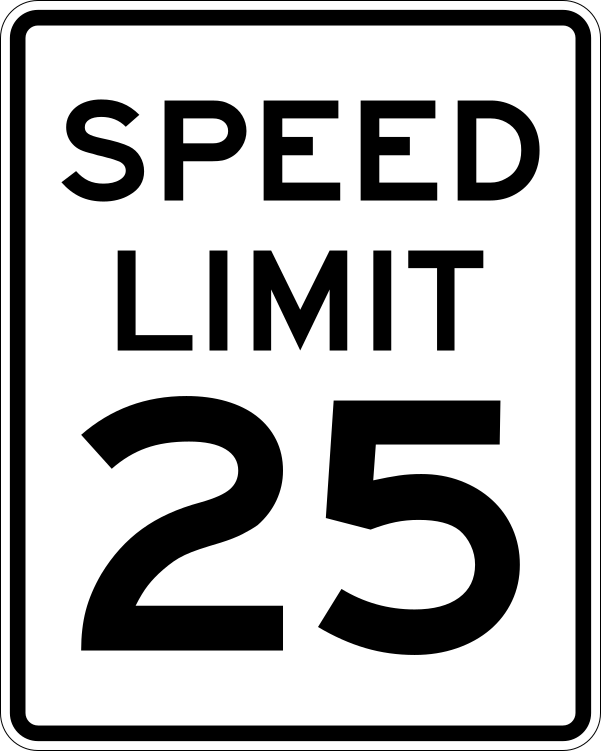
The posted speed limit is shown on this sign, but it is raining heavily. Which statement is true?
Study notes
California has a Basic Speed Law plus fixed limits for certain places. Test questions ask for exact numbers, so memorize the school, alley, railroad, and highway limits, and remember that bad conditions can make even the posted limit too fast.
Key numbers
- 65 mphTop speed on most California highways, unless posted otherwise
- 55 mphTwo-lane undivided highways, and any vehicle towing a trailer
- 25 mphNear a school (within 500 feet) while children are outside or crossing
- 25 mphBusiness and residential districts, unless posted otherwise
- 15 mphBlind intersections, alleys, and railroad crossings where your view of the tracks is limited
- 10 mphMost you may go when passing a bus, streetcar, or trolley stopped at a safety zone or light
- 30 mphSafe maximum when you can't see more than 100 feet ahead
- 5 mphMost you should go on ice
The Basic Speed Law
- Going faster than conditions safely allow is always illegal, even when you are under the posted limit.
- Base your speed on how many cars are around, how fast they are moving, the road surface, people or bikes on or crossing the road, and the weather.
- Slow down in heavy traffic or bad weather, but don't go so slowly that you block the normal flow of traffic.
- If you are slower than other traffic, use the right lane. If someone behind you wants to go faster, move right.
Highway limits
- Most California highways: 65 mph, unless a sign shows a different limit.
- Two-lane undivided highways: 55 mph, unless a sign says otherwise.
- Any vehicle towing a trailer: 55 mph.
Near people and buildings
- Schools: 25 mph when children are outside or crossing, within 500 feet of the school. Some school zones post limits as low as 15 mph.
- Business and residential districts: 25 mph, unless a sign shows another limit.
- Passing a bus, streetcar, or trolley that has stopped at a safety zone or a traffic light: 10 mph or less.
Places with a 15 mph limit
- Blind intersection (no stop signs on any corner): 15 mph. If your view is blocked, creep forward until you can see.
- Alley (a road 25 feet wide or less, used to reach the backs or sides of buildings): 15 mph.
- Railroad crossing: 15 mph within 100 feet of it if you can't see 400 feet down the tracks both ways. This limit doesn't apply when a flagman, gates, or a warning signal controls the crossing.
Bad weather
- Wet road: slow down by 5 to 10 mph.
- Packed snow: cut your speed in half.
- Ice: go no faster than 5 mph.
- If heavy rain or snow means you can't see more than 100 feet ahead, going faster than 30 mph is not safe.
From the California Driver Handbook: Section 8: Safe Driving (Continued) · Section 7: Laws and Rules of the Road (Continued) · Section 8: Safe Driving